Living in Fort Lauderdale: The Good, the Bad, and Zero Filter
Everyone is hyping up Fort Lauderdale right now. And honestly, a lot of that hype is deserved. But there is a version of this city you see on Instagram and a version that locals actually deal with every day — and those two versions do not always match up.
I'm Joe Vairo — a 2x eXp ICON Agent, ranked the #3 real estate agent in Fort Lauderdale by Fort Lauderdale Magazine, and founder of the Vairo Group, ranked the #3 real estate team in Fort Lauderdale. I grew up here, I live here, and my team helps people buy, sell, and relocate across South Florida every single day. This is not a sales pitch for Fort Lauderdale. This is the honest, unfiltered reality of what it actually looks and feels like to live here — category by category, with real scores on each one.
The Two Versions of Fort Lauderdale
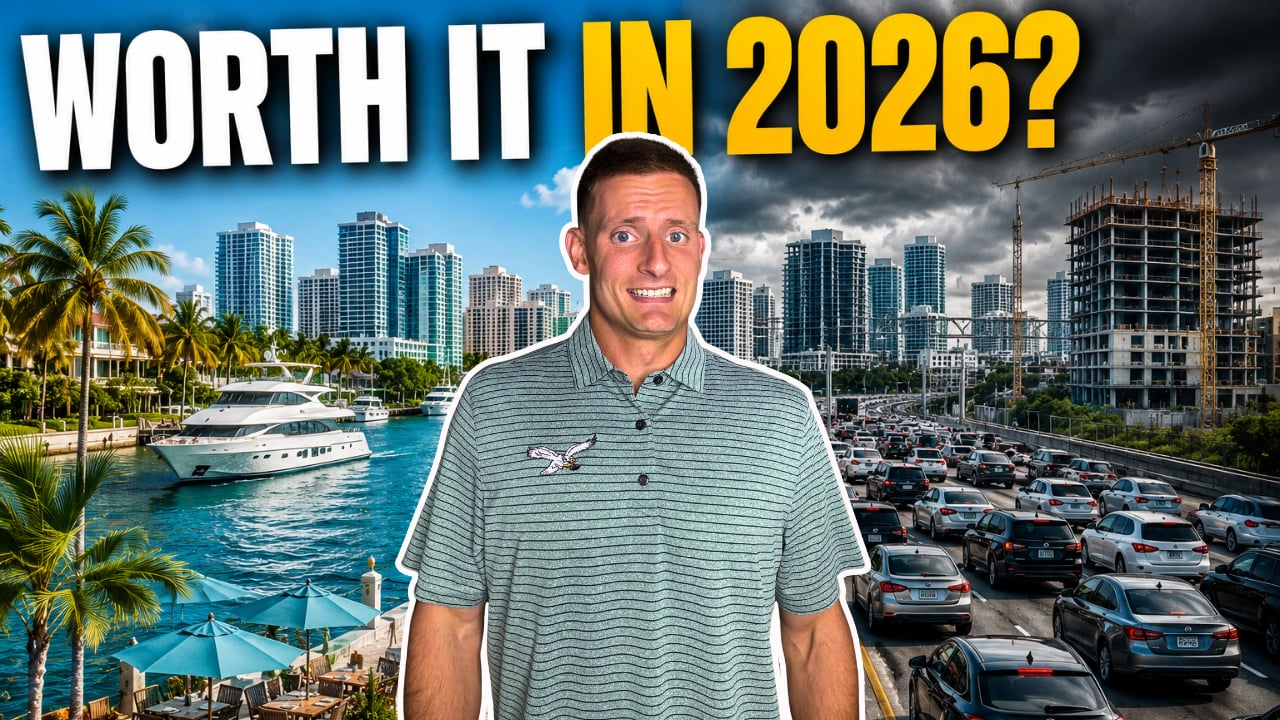
Before getting into the categories, it is worth acknowledging that Fort Lauderdale is genuinely a city with two faces — and understanding both is the starting point for making an honest relocation decision.
Version one is the Instagram version: the waterways, the yachts, the sunsets on Las Olas, the nightlife, Flagler Village, and the outdoor lifestyle that makes this city genuinely compelling. This version is real. It exists every day for the people who live here.
Version two is the version locals deal with on a day-to-day basis: the I-95 traffic that is getting progressively worse, the rain that shuts down entire weekends during summer, the insurance costs that can genuinely surprise buyers who did not do their homework, and the ways in which the city is changing faster than almost anywhere else in South Florida. This version is equally real.
The city is not one or the other. It is both simultaneously — which is why buyers who understand both versions make better decisions than buyers who only researched the first one.
Category 1 — Beach and Outdoor Lifestyle: 8.5 out of 10
The beach and outdoor lifestyle case for Fort Lauderdale is strong — but the honest version of it is slightly different from what most people expect before they move here.
Fort Lauderdale Beach itself is the obvious starting point, but most locals who live here year-round gravitate toward Lauderdale-by-the-Sea, Pompano Beach, and some of the quieter beach pockets within the broader Fort Lauderdale area rather than the main tourist-facing stretch of Fort Lauderdale Beach. The tourist and spring break crowd concentrates on Fort Lauderdale Beach proper — locals who know where to go tend to avoid it and find their own spots. If you are moving here and planning to hit Fort Lauderdale Beach on a Saturday afternoon in March, adjust your expectations. If you are moving here and planning to find the quieter local spots that full-time residents actually use, you will be fine.
The boating side of the outdoor lifestyle is where Fort Lauderdale genuinely separates itself from any other city on this list. Over 300 miles of inland waterways and canals — the Venice of America designation — and home to the largest in-water boat show in the entire world. Jet skis, paddleboards, kayaks, and everything up to serious yachts are part of daily life here in a way that is not performance or lifestyle marketing. It is just what people do. I live on the waterway and watch boats go by every single day. That experience is available across a wide range of addresses and price points in this city.
The caveats are real: tourist season brings crowds, Memorial Day weekend packs the water, and parking near the beach is a legitimate friction point during peak season. But for a buyer who is moving here to actually live the lifestyle rather than to visit it, the local knowledge of where to go and when makes most of those friction points manageable.
Score: 8.5 out of 10 — primarily because of the boating infrastructure and the hidden beach enclaves that full-time residents access without the tourist crowds.
Category 2 — Dining and Walkability: 7 out of 10
Walkability in Fort Lauderdale requires an honest conversation because the answer depends entirely on where you live within the city.
Downtown Fort Lauderdale, Flagler Village, and Galt Mile are the most walkable areas — but even within those neighborhoods, walkability is limited to the immediate corridor. If you live downtown, you are walking up and down Las Olas and staying in that area. If you are in Flagler Village, you are staying in Flagler Village. Lauderdale-by-the-Sea is probably the most genuinely walkable area in the broader Fort Lauderdale market — small enough that most things are accessible on foot or by bike. But across the city generally, a car, golf cart, or bike is a practical necessity for most daily errands.
The dining scene is legitimately improving and has been for several years. Daniel's Steakhouse, Runaway 84, Catch and Cut, Ocean Prime, Greek Islands, Tivara — the quality ceiling of Fort Lauderdale's restaurant landscape is rising. The new Sporesburg that opened in Flagler Village on weekends — a rotating food truck concept expanding from Miami — adds a different kind of food energy to the corridor. Las Olas remains the primary dining spine, with Galt Mile, Lauderdale-by-the-Sea, and the waterfront restaurant corridor along 17th Street offering legitimate alternatives.
The honest comparison, though, is that Miami is still significantly ahead of Fort Lauderdale on dining depth and variety. There is no Fort Lauderdale equivalent to Brickell's restaurant density or Miami Beach's dining scene. The gap is narrowing — the Caviar Club is coming, Falsetto Hospitality keeps building — but it exists and it is worth acknowledging.
Score: 7 out of 10 — improving meaningfully but not yet at the level of Miami or even some parts of Boca and West Palm for pure dining variety.
Category 3 — Real Estate and Affordability: 7.5 out of 10
The Fort Lauderdale real estate picture is more layered than the headline numbers suggest — and understanding the full cost structure is essential for buyers who are making a serious decision here.
The overall median sales price in Fort Lauderdale sits at approximately $560,000 across all property types. Single-family homes median at approximately $727,000. Waterfront single-family homes sit at a median around $2.3 million — a number that reflects the premium attached to the canal access and no-fixed-bridge infrastructure that defines the best of Fort Lauderdale's waterfront neighborhoods. On the condo and townhome side, the median is approximately $475,000.
The condo landscape in Fort Lauderdale is important to understand in context. The city has a significant inventory of older condos built in the 1960s, 70s, and 80s — buildings that carry varying levels of deferred maintenance, reserve funding issues, and the assessment exposure that has become a serious concern across South Florida following the Surfside tragedy. Newer boutique product — Aqua Blue, Aqua Vista, Adagio — represents a different tier. And the new construction pipeline coming — Pier 66 Residences, the St. Regis Bahia Mar, Andare, the Ritz-Carlton Residences on Fort Lauderdale Beach — will deliver a high-rise luxury product the city has not had before, at price points that reflect it.
The insurance piece is the variable that surprises most buyers from outside South Florida. East of I-95, home insurance is not a minor line item. Depending on elevation, roof age, plumbing condition, and whether the home has impact windows, annual insurance costs can range from approximately $6,000 to $20,000 to $30,000 for some of the older waterfront homes. This is not a Fort Lauderdale-specific issue — it is a South Florida-wide reality — but it disproportionately affects the older coastal inventory that makes up a meaningful portion of Fort Lauderdale's single-family market. The total cost of ownership calculation has to include insurance, and buyers who skip that step discover it painfully after closing.
HOA fees on condos add another layer: older buildings in the $600 to $1,000 per month range, newer luxury buildings ranging from $1,500 to $5,000 per month depending on the amenity package. Many condo HOA fees include master insurance, which partially offsets the cost — but the carrying cost on a Fort Lauderdale condo, particularly as a second or third home, is a real number that affects the investment math.
Score: 7.5 out of 10 — still more accessible than Miami, Boca, and much of West Palm, but the insurance and HOA realities mean the sticker price is not the full story.
Category 4 — Ease of Living: 8 out of 10
Fort Lauderdale sits in a genuinely comfortable position on the South Florida ease-of-living spectrum — more laid-back than Miami, more active than Boca and West Palm, with enough of both to serve a wide range of buyers.
The traffic caveat is real and getting more real. I-95 through Broward County is increasingly difficult during peak hours — the Broward Boulevard interchange in particular has become a genuine daily frustration, and while there are discussions about a diverging diamond conversion similar to what was done at Glades Road in Boca, the timeline on any infrastructure improvement is uncertain. This is not Miami-level traffic yet, but the trajectory is toward Miami and buyers should factor that into any commute-dependent lifestyle planning.
The infrastructure positives are meaningful. Fort Lauderdale-Hollywood International Airport is a legitimate major airport with direct flights to most major domestic and international destinations. The Brightline station connects Fort Lauderdale to Miami in approximately 30 minutes and to West Palm Beach in a similar timeframe — with service now extending to Orlando. For the buyer whose lifestyle involves regular trips to Miami without wanting to drive, the Brightline eliminates that friction in a meaningful way.
Score: 8 out of 10 — the Brightline and airport access elevate what would otherwise be a slightly lower score given the traffic trajectory.
Category 5 — Vibe and Community: 8 out of 10
The vibe in Fort Lauderdale is one of its most underrated and most genuinely appealing characteristics — and it is the thing that buyers who visit the city once tend to understand immediately and that is hard to convey in a listing description or a data point.
Fort Lauderdale is casual in the best sense of that word. You can go to dinner in flip-flops. People pull up to waterfront restaurants by boat and walk in directly off the dock. The social scene is centered around outdoor living and the water in a way that feels natural rather than performed. It is not the CNBC-scene, see-and-be-seen atmosphere that defines some of Miami's dining and nightlife culture. It is more relaxed, more genuine, and for a lot of buyers — particularly those who are done with the status-signaling aspects of their previous city — it is a significant relief.
The community character in Fort Lauderdale's residential neighborhoods is notably tight-knit for a city of this size. Rio Vista, Coral Ridge, Victoria Park, Imperial Point — these are neighborhoods where residents know their neighbors, where people are consistently outside walking and biking, and where the community identity is strong and self-reinforcing. That character is hard to manufacture and it is one of Fort Lauderdale's genuine assets for buyers evaluating it as a long-term primary residence rather than a seasonal destination.
Score: 8 out of 10 — the casual, water-centered, genuinely community-oriented character is a real differentiator for the right buyer.
Category 6 — Bang for Your Buck: 7 out of 10
Fort Lauderdale used to be meaningfully more affordable than Miami, Boca, and West Palm. That gap has narrowed considerably — particularly on the waterfront and on newer construction — and buyers who are making their decision based on Fort Lauderdale's affordability relative to where it was three or four years ago are working from an outdated picture.
Waterfront homes in Fort Lauderdale are appreciating rapidly and the inventory of older, smaller waterfront homes is being continuously upgraded — either torn down and rebuilt or gutted and renovated — which pushes the floor of the waterfront market higher with every transaction. The new construction condo pipeline, while genuinely exciting from a lifestyle standpoint, is priced at levels that reflect the premium the market now commands rather than the discount it offered historically.
The insurance variable adds a layer of cost that does not show up in the purchase price comparison but is very real in the total cost of ownership. Two adjacent homes on the same street can have dramatically different insurance costs based on elevation, roof age, and impact windows — meaning the purchase price comparison between Fort Lauderdale and other markets needs to be adjusted for the insurance reality before a true apples-to-apples cost comparison is possible.
Fort Lauderdale still offers better value than Miami and Palm Beach Island for comparable waterfront product. But the gap is not what it was, and the trend line is toward continued convergence.
Score: 7 out of 10 — still a value relative to Miami and Palm Beach, but no longer the outsized value it was and trending further in that direction.
The Bottom Line: Fort Lauderdale Is the Best Middle Ground in South Florida
After going through every category honestly, here is where I land: Fort Lauderdale might be the most misunderstood city in all of South Florida — because most people outside the market assume it is just a slightly calmer version of Miami, and it is really not that at all.
Fort Lauderdale has a little bit of Miami's energy and dining flair. It has a little bit of Boca and West Palm's refined, boating-conscious character. It has 300 miles of waterways that no other city in the country can match. And it has a community character and a casual lifestyle that is genuinely its own — not borrowed from the cities to the north and south of it.
Is it perfect? No. The traffic is getting worse. The insurance costs are real. The walkability outside of a few specific corridors is limited. And the affordability advantage relative to surrounding markets is narrowing.
But for the buyer who wants the best overall mix of lifestyle, water access, community character, location, and value in South Florida — Fort Lauderdale is still the answer I come back to more often than not. And after living here my entire life, that is not a sales pitch. It is just what I actually believe.
Thinking About Fort Lauderdale?
I'm Joe Vairo with the Vairo Group. Whether you are evaluating Fort Lauderdale against Miami, Boca, West Palm, or somewhere else entirely — I can give you the honest, ground-level context that makes the difference between a decision you feel confident in and one you second-guess.
📲 Text or call me at 954-830-1126 📩 Email me at [email protected] anytime — I respond personally
Joe Vairo is a 2x eXp ICON Agent, South Florida real estate agent, and Fort Lauderdale Magazine's #3 ranked agent in Fort Lauderdale. The Vairo Group, ranked the #3 real estate team in Fort Lauderdale, specializes in waterfront properties and luxury relocation in the $1M+ market.