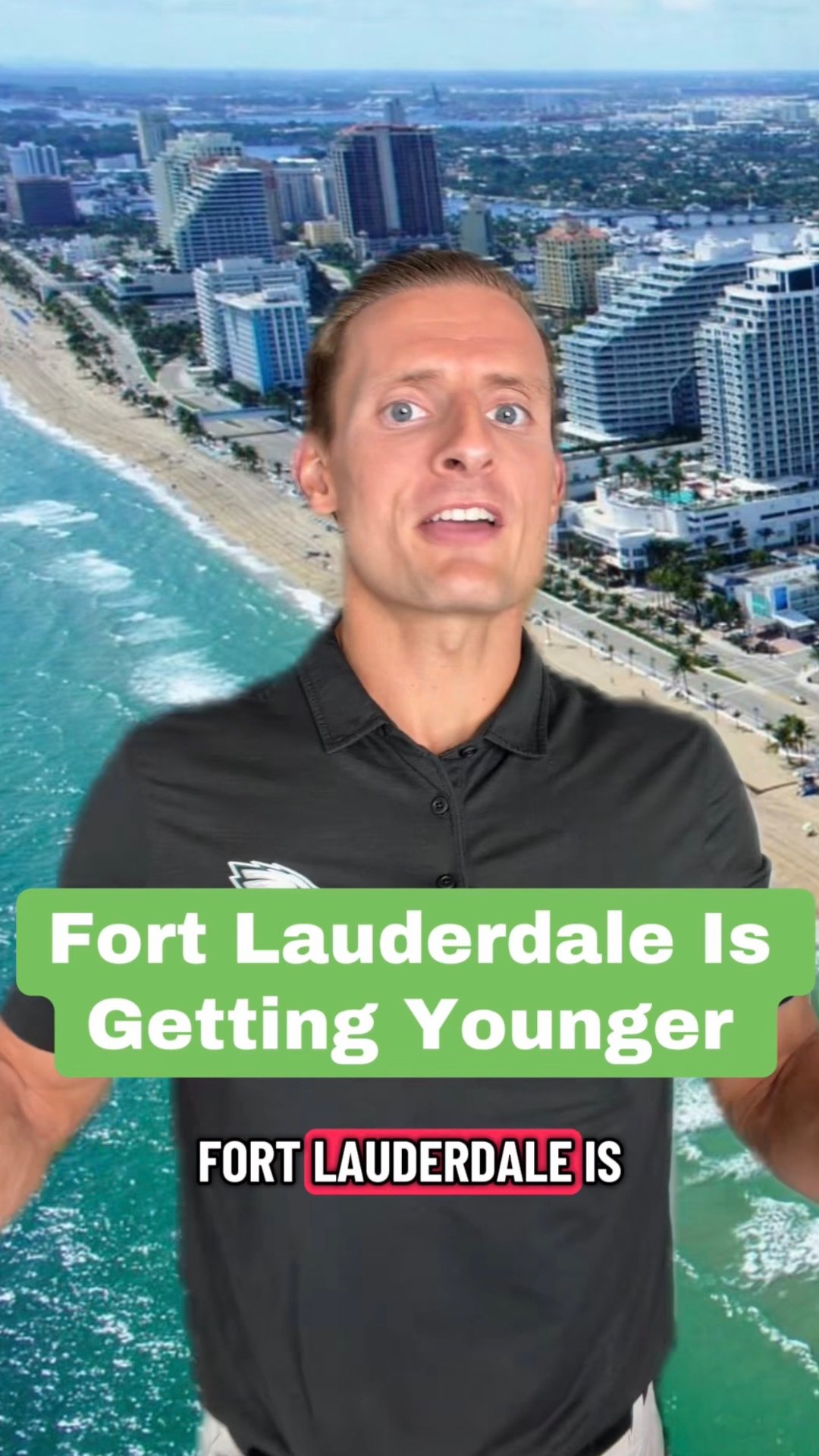
Fort Lauderdale Is Getting Younger — Here's What the Data Actually Shows
If you ask the internet what South Florida looks like, you will probably find the same tired assumption repeated over and over: retirees, golf, early bird specials. There is nothing wrong with that lifestyle, and plenty of South Florida absolutely delivers it. But that assumption about Fort Lauderdale specifically is increasingly and demonstrably wrong.
I'm Joe Vairo — a 2x eXp ICON Agent, ranked the #3 real estate agent in Fort Lauderdale by Fort Lauderdale Magazine, and founder of the Vairo Group, ranked the #3 real estate team in Fort Lauderdale. I cover this market every day, and the demographic data coming out of downtown Fort Lauderdale right now tells a story that contradicts the outdated perception most people outside South Florida still carry. Here is what the numbers actually show.
The Numbers: Downtown Fort Lauderdale Is Getting Significantly Younger
According to data from the Downtown Development Authority here in Fort Lauderdale, the population living in the downtown Fort Lauderdale area aged 25 to 44 has surged 25 percent since 2020. That is not a marginal shift — it is a substantial demographic change in a relatively short window.
The overall population gain in the downtown Fort Lauderdale area sits at 42 percent since 2020 — a figure that outpaces both Miami and West Palm Beach over the same period. For a city that has historically been characterized, fairly or not, as quieter and more retirement-oriented than its South Florida neighbors, outgrowing both Miami and West Palm in downtown population growth is a genuinely significant data point.
Perhaps most telling of all: families with children living in the downtown area have increased 85 percent over the last five to six years. That statistic alone dismantles the retiree-city perception more thoroughly than almost any other piece of data available. Downtown Fort Lauderdale is not just attracting young professionals — it is attracting young families who are choosing to raise children in an urban core, which is a meaningfully different and more committed kind of demographic shift than a temporary influx of young renters.
Why This Is Happening: Parks and Family-Friendly Infrastructure
The first driver behind this shift is something that does not always get credit in conversations about urban migration: Fort Lauderdale's downtown core is genuinely family-friendly, particularly when it comes to green space.
Holiday Park sits within easy reach with its fields, courts, and playground. Birch State Park offers a genuine nature preserve experience within the urban core — a rarity for a downtown this dense. George English Park and Bayview Park round out the nearby options, and The Fort adds a recreational and entertainment dimension that appeals to both adults and families. This concentration of accessible green space within a downtown urban core is not common, and it removes one of the primary objections families typically have to urban living — the perceived lack of outdoor space for children.
Why This Is Happening: Walkability
The second major driver is walkability — and the data on family migration to downtown only makes sense once you understand how genuinely walkable this corridor has become.
Living in the downtown core means you can walk, bike, or take a golf cart to the heart of downtown in under 10 minutes. Las Olas Boulevard, with its full restaurant, bar, and entertainment infrastructure, is immediately accessible. Flagler Village and the emerging FAT Village add further density and character to the corridor. The Riverwalk gives residents a dedicated path for running, biking, and jogging — and connects naturally to the local run club culture that has built a genuine fitness community along the water.
This is the live-work-play model that urban planners talk about constantly and that very few American cities actually deliver successfully. Fort Lauderdale's downtown core is increasingly delivering it — to the point where residents genuinely do not need to leave the neighborhood for most of their daily needs, while still maintaining a character that is distinctly different from both Miami and West Palm Beach.
What This Means for Buyers and Investors
This demographic data has real implications for anyone evaluating Fort Lauderdale's real estate market — whether as a primary residence buyer, a relocator, or an investor.
A downtown core that is attracting young professionals and families at this rate is a downtown core with sustained, structural residential demand — not a temporary pandemic-era blip that reverses as conditions change. The 85 percent increase in families with children specifically suggests this is a demographic that has made a long-term commitment to the neighborhood rather than a transient population cycling through rentals before moving elsewhere.
For buyers evaluating downtown Fort Lauderdale, Flagler Village, and the surrounding corridor, this data validates the underlying demand thesis that has been driving development in this area — the new construction pipeline, the retail and restaurant investment, and the continued build-out of FAT Village and the broader downtown core are responding to genuine, measurable population growth rather than speculative developer optimism.
For the buyer specifically comparing Fort Lauderdale to Miami and West Palm Beach as a relocation destination, this data point is worth weighing seriously. Outpacing both of those markets in downtown population growth since 2020 suggests that Fort Lauderdale's value proposition — the lifestyle, the walkability, the price point relative to its neighbors — is resonating with exactly the demographic that sustains long-term urban real estate appreciation.
The Bottom Line
Fort Lauderdale's downtown core is not the retiree-dominated, slow-paced city that outdated stereotypes about South Florida suggest. It is getting younger, it is attracting families at a remarkable rate, and it is outpacing both Miami and West Palm Beach in downtown population growth since 2020. The parks, the walkability, and the live-work-play infrastructure that downtown Fort Lauderdale has built over the past several years are working exactly as intended — and the data confirms it.
Thinking About Downtown Fort Lauderdale?
I'm Joe Vairo with the Vairo Group. If you want an honest, current conversation about what is happening in downtown Fort Lauderdale, Flagler Village, or the broader urban core — and whether it is the right fit for your relocation or investment plans — reach out directly.
📲 Text or call me at 954-830-1126
📩 Email me at [email protected] anytime — I respond personally
Joe Vairo is a 2x eXp ICON Agent, South Florida real estate agent, and Fort Lauderdale Magazine's #3 ranked agent in Fort Lauderdale. The Vairo Group, ranked the #3 real estate team in Fort Lauderdale, specializes in waterfront properties and luxury relocation in the $1M+ market.